
Business & enterprise
Connect sites, assets and people to data you can act on, starting with a scoped pilot rather than a large commitment.
Use cases
Illustrative directions. Each is scoped per site and per organisation.
Asset twins
Represent equipment and infrastructure with Helix Asset Twins, so each asset has an identity, relationships and a lifecycle.
Learn more →Place twins
Model a campus, site or facility as a Helix Place Twin and link assets, events and people to it.
Learn more →Measurement
Define metrics once and track progress over time with ViSE inside MTRX, with source and method documented.
Learn more →Amenity infrastructure
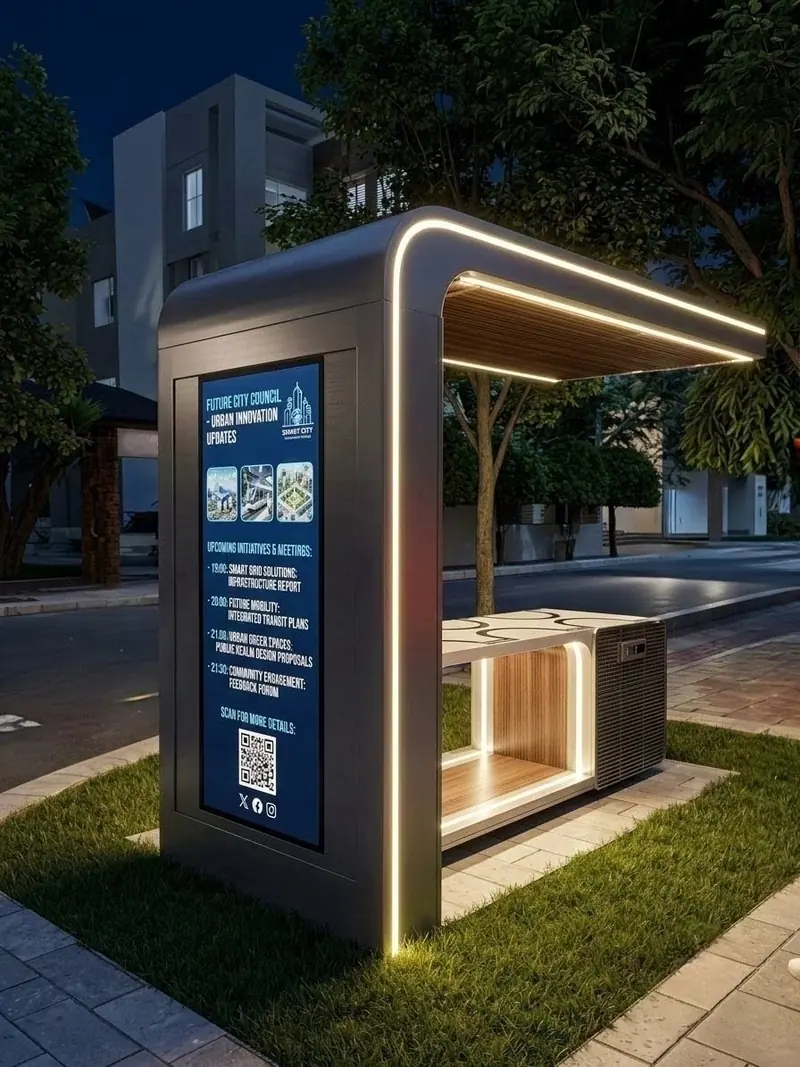
Solar-powered seating and digital amenities for campuses, offices and public-facing sites, starting from the Smart Solar Bench.
Learn more →Hospitality and retail concepts
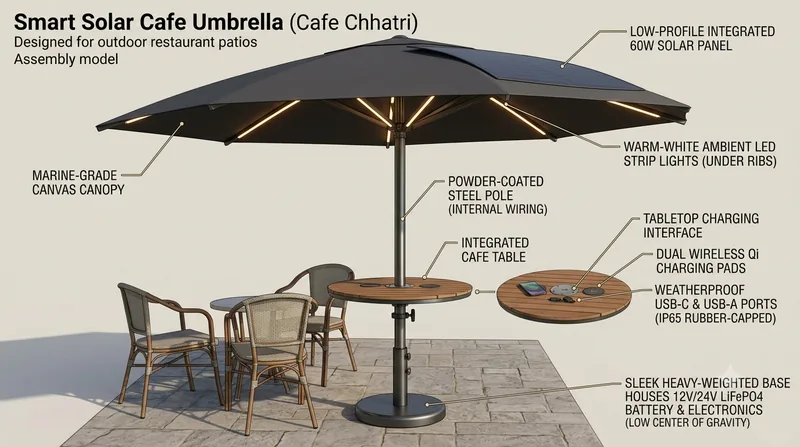
Concept directions such as a solar café umbrella with integrated charging, shown only as concepts.
Learn more →Research partnership
Joint work with DoubleSlit and YNTR on sensing, IoT and edge computing, with maturity labelled.
Learn more →What you get from a pilot
A pilot is bounded, measured and documented.
- A written site assessment covering energy, connectivity, safety and approvals
- A configuration and quotation, not a generic price list
- Installation of the agreed node or platform scope
- Defined measures, with method and time period stated
- A close-out summary that records what worked, what did not and what to change
You decide on scale-up only after the pilot evidence is in.
Sites and assets in context
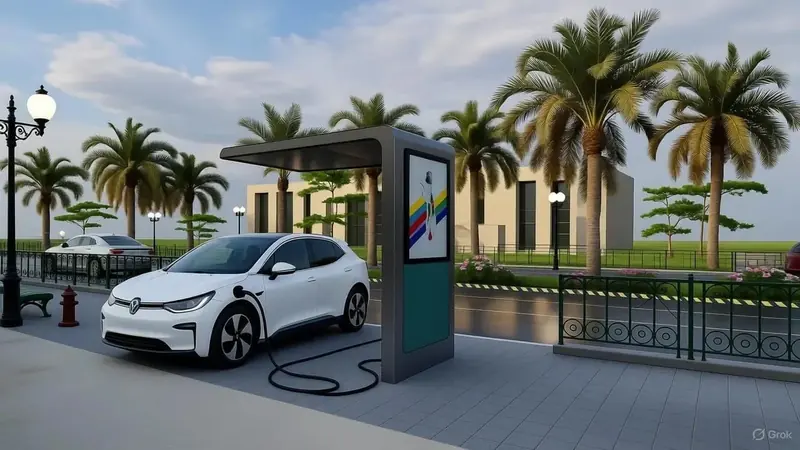
The pilot-proven bench design, plus concept directions for hospitality and charging sites.
Deployment approach
Discovery and site assessment before any commitment.
Assess
Energy, connectivity, safety and local requirements are reviewed for each site.
Configure
The configuration is chosen for your needs. Pricing is configuration dependent and quoted per project.
Pilot first
A bounded installation with defined measures. Scale only on evidence.
The asset-intelligence path
Turning physical assets into intelligent assets, step by step. How far you go is a scoping decision.
- Asset identity
- Condition
- Telemetry
- History
- Anomaly detection
- Predictive maintenance
- Lifecycle optimisation
The first four steps rely on Helix identity and instrumented data. Anomaly detection, predictive maintenance and lifecycle optimisation are designed capabilities that are available only where implemented and validated for your assets.
Simulate before you act
Digital twins should help organisations explore the future, not only describe the present. Typical what-if questions for a site:
Simulation is a per-project capability. Scenario models are built from your data and documented assumptions, and results are shown as estimates.
Where it applies
Typical enterprise settings.
Factories and industrial parks
Equipment identity, condition and maintenance history.
Campuses and office parks
Place twins linking buildings, utilities and amenities.
Warehouses and facilities
Asset registers, usage and environment.
Energy infrastructure
Solar nodes and storage as monitored assets.
Fleet and mobility
Vehicle and charging asset identity and usage.
Hospitality and retail
Solar shade and amenity concepts, shown only as concepts.
Enterprise questions
Do you offer standard pricing?
No. Pricing depends on configuration, site and scope, and is provided by quotation after a site assessment.
Is edge AI included?
Not in V1.0. Edge AI and computer vision are research or future-variant capabilities until installed and validated.
Can I see live data?
Sample dashboards are labelled as sample. Live values name their source device and timestamp.
How long does a pilot take?
Timelines depend on configuration and site readiness and are stated in the proposal.
Can this connect to our existing systems?
Yes, where a project needs it. The platform is designed to connect to existing IoT, GIS, identity and enterprise systems; integrations are documented per project. See interoperability.
Where does our data live?
Cloud, on-premise, edge, hybrid and private deployments are options scoped per project, and data ownership and retention are written into the agreement. See security and data governance.
Ready to scope a pilot?
Tell us about your site and what you want to achieve. We respond with a site assessment plan and a quotation based on your configuration.